Breaking News




Popular News





Enter your email address below and subscribe to our newsletter
Virtual Assistant Blog
Virtual assistants are transforming how businesses operate by handling tasks remotely with efficiency and flexibility. This complete guide explains how virtual assistants work, including their workflows, tools, communication systems, and pricing models—helping you understand how to leverage them for growth.

Virtual assistants (VAs) have become a cornerstone of modern business operations, especially in an era defined by remote work, digital entrepreneurship, and global collaboration. From solo entrepreneurs managing multiple roles to large corporations optimizing workflows, virtual assistants provide scalable, cost-effective support across a wide range of functions.
But how do virtual assistants actually work behind the scenes?
This comprehensive guide breaks down everything—from the operational structure and workflows to tools, communication systems, pricing models, and real-world execution. Whether you’re a business owner considering hiring a VA or a professional looking to become one, this deep dive will give you a clear understanding of how the entire ecosystem functions.
A virtual assistant is a remote professional who provides administrative, technical, or creative support to clients from a distance. Unlike traditional employees, VAs typically operate as independent contractors or freelancers.
At its core, the VA-client relationship follows a structured workflow. Understanding this is essential to grasp how virtual assistants function efficiently.
Everything begins with identifying what the client needs. This can happen through:
Clients typically outline:
Once the scope is clear, tasks are assigned. These can include:
Tasks are usually documented in:
The VA completes tasks using various tools and systems. Execution depends on:
Regular updates ensure alignment. This includes:
Clients provide feedback, and processes improve over time:
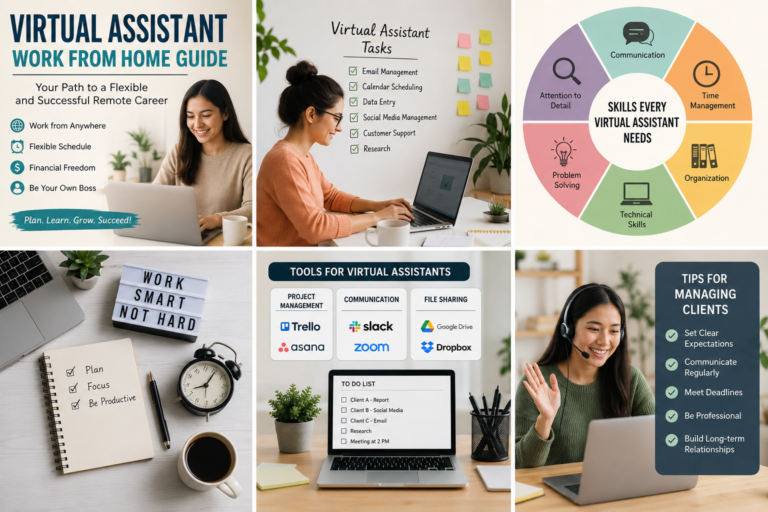
Virtual assistants rely heavily on digital tools to operate seamlessly. These tools form the backbone of their productivity.
These tools allow VAs to work across time zones while maintaining real-time collaboration.
Virtual assistants can handle a wide range of tasks depending on their specialization.
Communication is the lifeline of a successful VA relationship.
Real-time interaction:
Delayed responses:
One of the biggest advantages of virtual assistants is global availability.
A US-based client assigns tasks at the end of their day. A VA in Asia completes them while the client sleeps.
Virtual assistants use several pricing structures.
A structured onboarding process ensures smooth collaboration.
Since VAs handle sensitive data, security is critical.
Standard Operating Procedures (SOPs) are essential for scalability.
Task: Email Management
Steps:
Top VAs don’t just complete tasks—they optimize them.
Automation reduces manual work and increases productivity.
Clients often track VA performance through:
Businesses often start with one VA and scale up.
Successful integration involves treating VAs as part of the team.
Many VAs and clients connect through platforms like:
These platforms provide:
Let’s break down a typical day:
The VA industry is evolving rapidly.
Virtual assistants are not just task-doers—they are productivity partners. They enable businesses to:
Understanding how virtual assistants work allows you to leverage them effectively—whether you’re hiring one or becoming one.
Virtual assistants operate through structured workflows, supported by powerful tools, clear communication systems, and scalable processes. Their ability to adapt, optimize, and integrate into business operations makes them indispensable in today’s digital economy.
If implemented correctly, a virtual assistant can transform how a business operates—turning chaos into clarity and workload into streamlined efficiency.
A virtual assistant handles remote tasks such as email management, scheduling, customer support, data entry, social media management, and more, depending on their specialization.
Virtual assistants use tools like email, Slack, Zoom, and project management platforms to maintain consistent communication through both real-time and asynchronous updates.
Costs vary depending on experience and location. Rates typically range from $5 to $50+ per hour, or clients may choose monthly retainers or project-based pricing.
Yes, most professional virtual assistants follow strict security practices, including NDAs, password managers, and limited access permissions to protect client data.
Businesses start by identifying tasks to outsource, hiring a VA through platforms or direct outreach, and onboarding them with clear instructions, tools, and workflows.