Breaking News



Enter your email address below and subscribe to our newsletter
Virtual Assistant Blog
Discover how to become a virtual assistant with this beginner-friendly guide covering skills, tools, income potential, and how to get your first client.

So you’ve decided you want to become a virtual assistant. Translation: you want to get paid to do useful things for other people without commuting, office politics, or pretending to enjoy team-building exercises.
Good instinct.
Virtual assistant (VA) work has exploded over the last few years thanks to remote work, digital businesses, and the universal realization that most tasks can be done from a laptop and a decent internet connection.
But here’s the part people conveniently ignore: it’s not “easy money.” It’s real work, with real expectations, real clients, and real competition.
This guide walks you through everything you need to know to start your VA journey the right way.
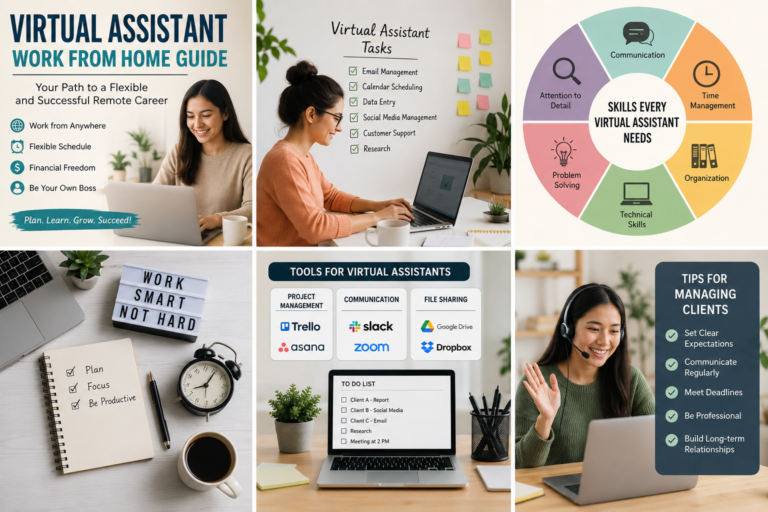
A virtual assistant is a remote professional who provides administrative, technical, or creative support to businesses or individuals.
Think of it as being the person who keeps everything from falling apart, just without sitting in someone else’s office.
Businesses don’t hire VAs out of generosity. They hire them because it saves time and money.
A VA is often cheaper than a full-time employee and more flexible. That makes you valuable… if you actually deliver results.
You don’t need a fancy degree, but you do need competence.
Clear, concise communication prevents confusion and mistakes.
No one is going to supervise you. That’s both freedom and a trap.
You’ll juggle multiple tasks across clients.
Basic knowledge of tools like:
Clients love VAs who fix issues without constant hand-holding.
Not all VA work is the same. Pick a direction before you try to do everything and end up doing nothing well.
Handles emails, scheduling, and general admin work.
Manages content, posts, and engagement.
Supports online stores (orders, listings, customer service).
Writes, edits, or manages content.
Handles websites, automation, and tools.
You don’t need to master everything, but you do need to be comfortable with tools.
The faster you learn tools, the more useful you become.
List what you already know. You probably have more skills than you think.
Trying to serve everyone makes you forgettable.
Show examples of your work, even if you have to create mock projects.
Start reasonable, not desperate.
Use platforms like:
It depends on your skills, experience, and confidence.
$3–$10/hour
$10–$25/hour
$25–$50+/hour
Yes, you can earn more. No, it won’t happen overnight.
Contact businesses directly.
Working for pennies is not a strategy.
If you can’t deliver, don’t offer it.
Clients hate being ignored.
Generalists struggle more.
Once you gain experience:
Virtual assistant work is one of the most accessible ways to start earning online.
But accessibility doesn’t mean effortless.
If you treat it seriously, build real skills, and deliver consistent value, you can turn it into a reliable income stream.
If you treat it like a shortcut, you’ll get exactly what shortcuts usually give: disappointing results.
No, but you need skills.
It varies. Could be weeks or months.
Yes, if you commit to learning and improving.